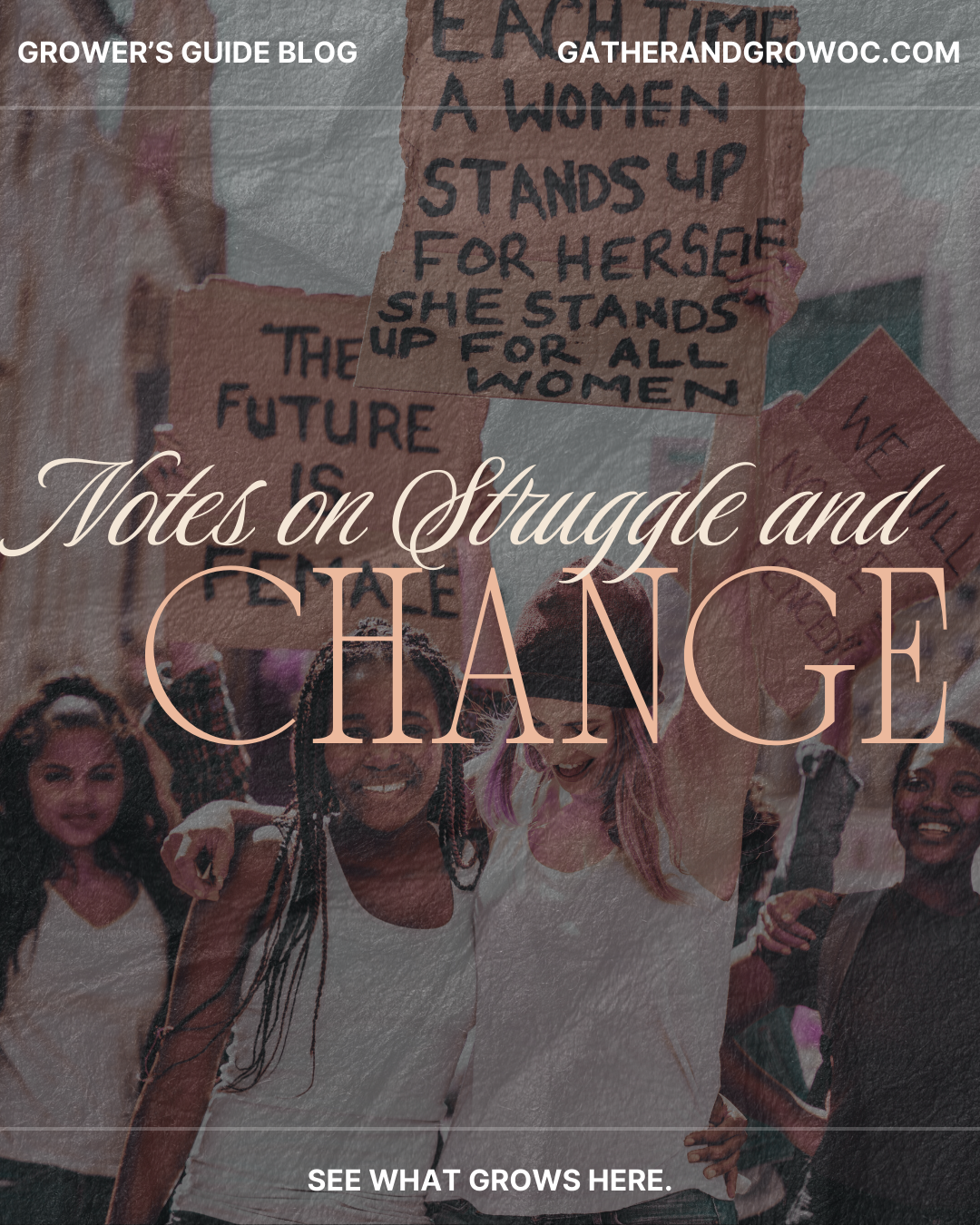
Notes on Struggle & Change
Struggle and change often live in the same place. It’s not easy, but we’re here to help.

ggoc Newsletter — March 2026 — Women’s History Month
Struggle and change often live in the same place.
Dear Community,
March is Women’s History Month, and it invites us to tell the truth about how change actually happens. It is rarely clean, linear, or comfortable. Most of the breakthroughs we now call “progress” were born in the middle of struggle:
When people were exhausted,
when the stakes were high,
and when the old ways stopped working.
This month, we are holding that intersection with care. Therapy is another place we see this, sometimes uncomfortable but always growth-inducing, relationship. All the waves and contradictions of getting to know our wounds and attending to our healing remind us that liberation is not just a headline. It is a daily practice of refusing what harms us, naming what we need, and building what we have not yet seen.
Struggle is not a sign that you are doing it wrong. Often, it is evidence that something is shifting.
When we feel grief, it can mean we are finally telling the truth about what we lost.
When we feel anger, it can mean we have located the boundary that was crossed.
When we feel fear, it can mean we are stepping toward something new.
Change asks us to stay present in that messy middle. Not to romanticize hardship, but to remember that transformation takes time, support, and community.
Women’s History Month: remembering, honoring, continuing
Women’s history is a story of organizing, mutual aid, risk, creativity, and persistence. It is also a story of who was left out, who was erased, and who kept going anyway.
This month, we honor:
The organizers who fought for voting rights, labor protections, and bodily autonomy.
The movement leaders who taught us that “women’s rights” must include racial justice, disability justice, economic justice, queer and trans liberation, and immigrant justice.
The everyday people who changed their families, workplaces, neighborhoods, and communities by choosing courage again and again.
A gentle invitation for March
If you are in a season of struggle, we want you to feel less alone.
Here are a few questions to sit with this month:
Where am I being asked to change, even if I did not choose the timing?
What support would make the next step feel possible?
What truth do I keep minimizing to stay comfortable?
What would it look like to treat my healing as part of the movement?
Change is not only made in big moments. It is made in repeated choices.
Small actions that build real change:
Reach out to someone who has been on your mind.
Learn one piece of local women’s history and share it.
Donate, volunteer, or amplify a women-led effort you trust.
Rest on purpose, especially if you have been in survival mode.
Practice one boundary that protects your time, energy, or body.
With you, in the work
At Gather & Grow OC, we believe community is a strategy. We believe care is not separate from change. We believe we do not have to earn rest, safety, or belonging.
If this month feels heavy, we are holding space for you. If this month feels energizing, we are celebrating with you. Either way, you do not have to move through it alone.
With love and solidarity,
Gather & Grow OC
P.S. If you want to reply and tell us what you are navigating this season, we read every message (hellogatherandgrowoc.com).
(If you are in crisis or need immediate support, please reach out to local emergency services or a trusted support line in your area.)
Why You’re Allowed to Skip New Year’s Resolutions
Therapists’ Perspective on Rest, Growth, and Letting Yourself Be Human
Every January, we’re told it’s time to fix ourselves.
New habits. New body. New mindset. New productivity level. New you.
As therapists, we want to offer a gentler—and more honest—truth: you don’t need a New Year’s resolution to be worthy of care, rest, or growth.
For many people, especially those navigating grief, trauma, burnout, or systemic stress, New Year’s resolutions can feel less like motivation and more like pressure. And that pressure often leads to shame, not change.
Let’s talk about why it’s okay to opt out—and what to do instead.
The Problem With New Year’s Resolutions
From a mental health perspective, traditional New Year’s resolutions are often:
Rooted in perfectionism
Tied to diet culture or productivity culture
Based on punishment rather than care
Unrealistic given real-life stressors
Research consistently shows that most resolutions are abandoned within weeks—not because people are lazy or lack discipline, but because willpower is not a sustainable mental health strategy.
If your nervous system is already overwhelmed, adding another “should” won’t help.
Resolutions Don’t Account for Context
Resolutions often ignore reality.
They don’t account for:
Chronic illness or disability
Mental health challenges like anxiety or depression
Financial stress
Grief and loss
Marginalization or identity-based stress
As queer-affirming therapists, we see how systems of oppression already demand more from LGBTQ+ folks, people of color, disabled people, and caregivers. Expecting yourself to “level up” on January 1st without acknowledging these realities is not self-improvement—it’s self-erasure.
You Are Not a Problem to Fix
One of the most harmful messages behind New Year’s resolutions is this:
Who you are right now isn’t enough.
But mental health isn’t about becoming someone else. It’s about learning how to live more compassionately with who you already are.
Growth doesn’t require shame. Healing doesn’t require urgency.
What to Try Instead (Therapist-Approved Alternatives)
1. Choose an Intention, Not a Resolution
Intentions focus on how you want to feel, not what you want to achieve.
Examples:
“I want to prioritize rest.”
“I want to move at a pace that honors my capacity.”
“I want to practice self-compassion when things feel hard.”
Intentions leave room for flexibility and humanity.
2. Practice Values-Based Living
Instead of rigid goals, ask:
What matters to me right now?
What do I want to protect this year—my energy, my joy, my boundaries?
Values-based choices are more sustainable than outcome-based goals.
3. Let This Be a Year of Maintenance
Not every year is for growth. Some years are for survival, stabilization, and rest.
Maintenance might look like:
Taking your meds consistently
Going to therapy
Saying no more often
Doing less—and feeling okay about it
That counts. Truly.
4. Start Where You Are—Not Where You “Should” Be
If January feels heavy, slow, or emotionally complicated, listen to that.
Healing is not linear. Mental health doesn’t follow a calendar.
You’re allowed to begin again on any random Tuesday—or not at all.
A Gentle Reminder
You don’t owe the New Year a better version of yourself.
You are allowed to:
Rest without earning it
Change slowly
Stay the same
Need support
Opt out of resolutions altogether
From the therapists’ perspective, the most radical thing you can do this year might be treat yourself with kindness instead of demands.
Looking for Support This Year?
If the pressure of “New Year, New You” brings up anxiety, shame, or burnout, therapy can help you untangle those messages and reconnect with what actually supports your mental health.
Gather and Grow OC offers LGBTQ-affirming, trauma-informed therapy for clients in California and beyond—supporting you exactly as you are, not who you think you should be.
Reach out HERE. We're here to listen when you’re ready.
Holiday Survival Guide 101
The holidays can be a mixed bag: twinkly lights, cozy sweaters, and joyful gatherings—and complicated family dynamics, grief, loneliness, financial stress, and emotional exhaustion. Whether you’re excited, overwhelmed, or somewhere in between, your feelings are valid.
As a queer therapist, I see how this season amplifies everything. You’re not doing anything “wrong” if the holidays feel hard. You’re human.
Below are some gentle, practical ways to take care of yourself during this season, especially if you're navigating identity, boundaries, or just trying to stay afloat.
1. Check In With Your Body Before You Commit
Before saying yes to events, gifts, or obligations, pause and ask:
Do I have the energy for this?
Does this feel like a “should” or a genuine want?
What happens in my body when I consider saying yes—or no?
Your body often knows the truth before your brain does.
2. Give Yourself Permission to Set (or Re-set) Boundaries
Boundaries are a gift to yourself—not a punishment for others.
You might say:
“Thanks for the invite, but I won’t be able to make it this year.”
“I’m stepping away from this conversation.”
“I’m not comfortable discussing my dating life/my gender/my job right now.”
You don't need a long explanation. “No” is a complete sentence, even during the holidays.
3. Create Chosen Family Moments
If your biological family relationships feel strained—or unsafe—spend time with people who make you feel grounded and seen. That might look like:
A holiday movie night with friends
A virtual hangout
A cozy date night with your partner
Solo joy: baking, crafting, gaming, reading queer romance novels
Chosen family is real family.
4. Plan for Emotional Flashpoints
Think ahead about what may come up:
Feeling outnumbered in political conversations
Misgendering
Old wounds resurfacing
Sensory overload
Loneliness or grief
Make a small “holiday coping plan”:
What helps you feel calm?
Who can you text if things get hard?
What’s your exit plan if you need space?
Preparation isn’t pessimistic—it’s protective.
5. Manage Financial Pressure With Compassion
Capitalism pushes us to equate love with spending. You do not need to go into debt to show you care.
Try:
Handmade or low-cost gifts
Experiences instead of items
Setting a budget and sticking to it
Normalizing “I’m keeping gifts simple this year”
Your worth isn’t defined by what’s under the tree.
6. Build Rest Into Your Schedule (on Purpose)
The holidays easily fill up with obligations. Rest doesn't happen by accident—schedule it.
Ideas:
One “do nothing” night a week
A morning without plans
A quiet walk or stretch session
Turning off notifications for a few hours
Rest is a radical act, especially when the world keeps telling you to do more.
7. Honor Your Grief and Mixed Feelings
Joy and sadness can coexist. You don’t have to force holiday cheer.
If you’re grieving someone or something—a loved one, a relationship, the version of yourself you were last year—make room for it. Light a candle. Look at a photo. Say their name. Journal. Let it be present without judgment.
Grief is love. Letting it be is a form of self-care.
8. Make Space for Small Joy
You don’t need a perfect holiday to feel good. Micro-joys count:
The smell of pine or cinnamon
A warm blanket
Listening to your favorite playlist
Watching your pet be chaotic
Sipping something warm
Joy doesn’t need to be loud to be real.
9. Seek Support if You Need It
If this season brings up more than you can carry alone, that’s okay. Therapy is a space to unpack stress, grief, identity, and boundaries without judgment.
If you’re in California and looking for mental-health support, Sad But Rad Therapy offers LGBTQ-affirming, trauma-informed care to help you navigate tough seasons with compassion.
Final Reminder
You don’t need to earn rest. You don’t need to “perform” holiday cheer. You don’t need to push through discomfort to make others happy.
You deserve a holiday season that feels safe, gentle, and authentically yours.
You’re allowed to take care of yourself first.
Apologies & Accountability
When it comes to apologies and accountability, it's not just about saying "sorry" - it's about acknowledging the impact of our actions. Understanding the difference between a genuine apology with accountability versus an excuse can transform how we handle conflicts and build stronger relationships. Let's explore how to apologize effectively while validating others' experiences.
One of the hot topics I see in work with clients, and even in my personal and social life, is the act of apologies and accountability. People tend to apologize, and sometimes it doesn't feel like an apology — but why is that?
I observe that people think apologies aren't enough due to a lack of accountability. People often hear "I'm sorry you felt this way," which leaves a bad taste in some people's mouths, or "I'm sorry, but..." which can feel like an excuse or make the apology more about the person apologizing than the one who felt hurt.
How do we properly apologize? First, it varies by person and what the individual wants—it's always good to understand and figure that out. On a general basis, though, it's always good to take accountability when you apologize.
For people who are neurodiverse and others who don't identify as that but who are over-explainers, they may want to avoid being misunderstood in situations where their intent wasn't malicious. Sometimes, it's good to have others understand the situation, but sometimes, we don't have to explain our intent if the person knows we meant no harm. If you need to explain a bit of a misunderstanding, it can be helpful to do that first, then end with an apology and validation.
Again, when people feel hurt, they want validation that they were hurt and that the events and actions hurt them. It's essential to understand the hurt side. It doesn't mean the person who caused the hurt has to validate that they're bad or that their intention was malicious, but rather validate that their action hurt the individual.
LOVE > Hate
“I wrote this personal piece as a way to process my outrage and, ultimately, help myself stay grounded in love and solidarity with my community. I hope reading it can be as therapeutic as it was to write." -SG
“I wrote this personal piece as a way to process my outrage and, ultimately, help myself stay grounded in love and solidarity with my community. I hope reading it can be as therapeutic as it was to write.””
"Love>Hate"
I refuse to let this heartache harden my bleeding heart.
I refuse to wear hatred like an armor.
Just to try and protect myself from what it feels like to witness the painful consequences of ignorant actions.
Instead, I will let this heartache crack my heart open.
I will let this heartache seep in through the wide-open seams and let love persist.
Ignorance will not quiet my voice.
Hate will not harden me.
Abuse will not steal my spirit.
Manipulation will not dissolve my integrity.
Control will not rob me of the freedom inside my expansive heart.
I do this for the children who are separated from their honorable hard-working immigrant parents.
I do this for the trans teen who just wants to feel comfortable in their own skin.
I do this for those who want a choice in how a pregnancy can affect their bodies, health, & futures.
I do this for the parents who want to send their children to school without fear that their lives will be lost to gun violence.
I do this for the BIPOC communities who have been surviving cycles of trauma, substance abuse, incarceration, and poverty due to sustaining oppressive systems.
All of which could be solved if the power-holding billionaires could put their egos aside. If they could lead with curiosity instead of fear when they feel threatened by something different that they don't understand. If they could come down from their cushy ivory towers and spare the chunk change of their gluttonous wealth to help someone other than themselves.
If they could have the humility to remember that the dollar signs next to their net worth doesn't make them more valuable or worthy than anyone else.
If they could have the sight to see, that their privilege doesn't make them an exception to the inevitable cycle of life every natural creature on this miraculous planet they refuse to take care of is a part of.
If they had the moral compass to keep their actions in check knowing that the universe doesn't grant pardon to the rich from the Karma they've acquired that will follow them into the next life from the countless lives their willful ignorance has impacted.
But here's the truth of it, the sad truth of it.
No amount of privilege can make you special.
No amount of success can make you happy.
No amount of power can make you worthy.
No amount of control can make you feel safe.
No amount of money can make you feel enough.
And let's face it, it's never enough.
None of this matters in the end if you have to sell your soul and integrity for it.
No amount of riches, accolades, fame, or followers will ever satiate that gaping hole inside you. The one that you've guarded so well that only in the quiet, lonely, stillness can you hear the whispers you've tried to keep at bay saying "You're not enough. You'll never be good enough."
Like a fearful child hiding under an innumerable amount of safety blankets in hopes they will protect you from the scary monster that is just the darkness of your own shameful shadow.
You've armored your heart proudly because if you didn't, you would have to feel this. What pain you must be in. The decades of ignoring this pain are written all over the puckered look on your faces. So I won't let this heartache turn into hate and armor my heart like you. The grief my heart holds is what allows me to care for someone other than myself.
We may not have unsatiating amounts of money, possessions, privilege, or fame. However, we do have community, healing, joy, connection, compassion, innate worthiness, soul, and love.
We are love. You just forgot.
And love, always prevails.
-SG
Coping With Grief During the Holidays
The holidays can bring up complex emotions and grief. Here are some gentle tips for finding balance while honoring your feelings during this time. 🕊️
With the holiday season approaching, we recognize that this time of year can stir up complex emotions, especially for those navigating grief. To help you find balance and comfort, here are some supportive tips to process and manage strong feelings while honoring the holiday season.